Multi-marketplace order routing: the right node and carrier, before the ship-by date
Updated · Ecomsellertool
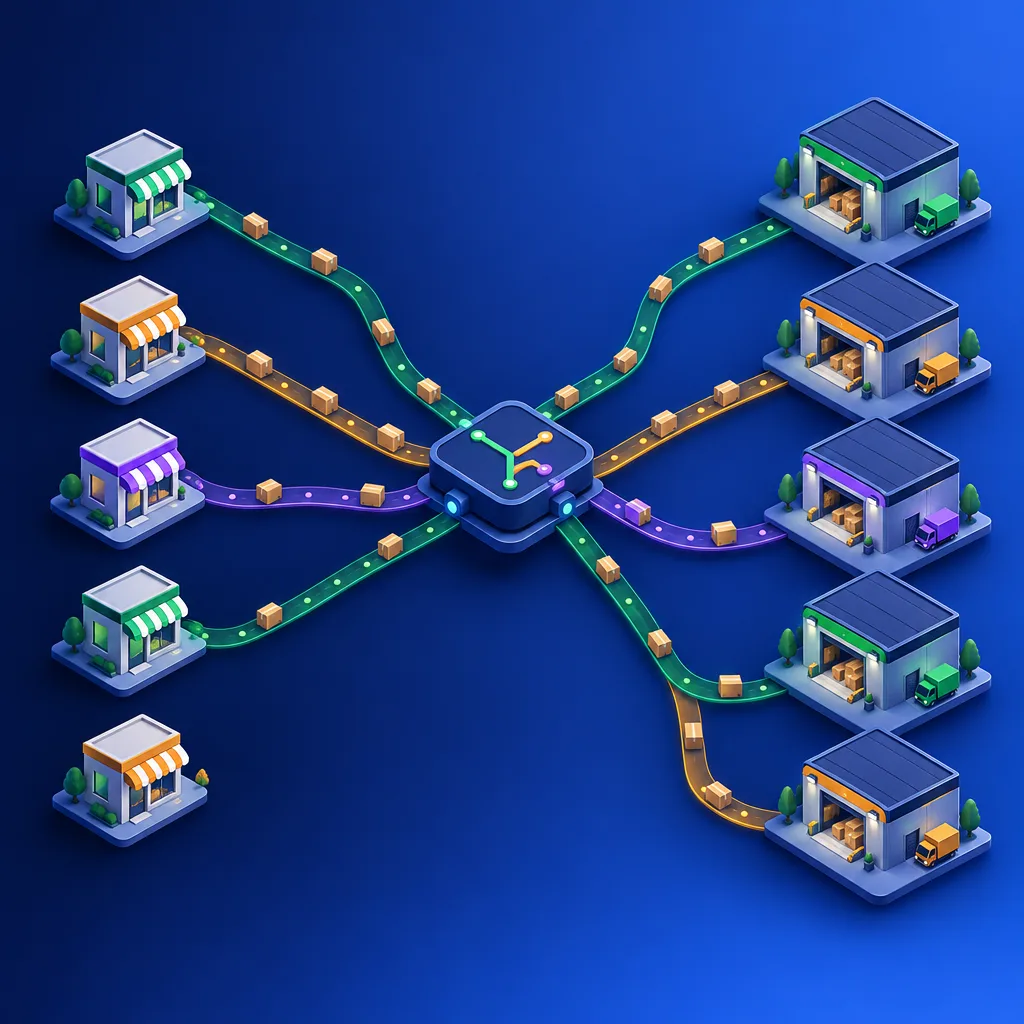
Multi-marketplace order routing decides, for every order from Amazon, Walmart, Shopify, eBay or TikTok Shop, which stock location ships it and with which carrier. A sound router checks that one node holds the whole order, that the parcel gets a carrier scan before the channel's ship-by date, and what it costs to pick, pack and deliver, then writes tracking back. Growth OS applies those rules across your warehouse, 3PLs and Amazon MCF from one order queue.
- Walmart expects a Late Shipment Rate at or below 5% on self-fulfilled orders; an order counts as late if it is marked shipped or first scanned by the carrier after its Expected Ship Date, or has no valid first scan.
- eBay treats a tracked order as late only if it arrives after the latest estimated delivery date and the carrier never scanned it within the seller's handling time.
- Amazon Multi-Channel Fulfillment ships orders from other channels out of the same FBA inventory pool, with Standard delivery in three business days and Expedited in two.
- Walmart orders fulfilled through MCF must ship in blank boxes with Amazon Logistics blocked; as of September 2026, Amazon has waived its usual 5% alternate-carrier surcharge until January 14, 2027.
- As of September 2026, US MCF fulfillment fees carry a 3.5% fuel and logistics surcharge, and holiday peak fees apply from October 15, 2026 to January 14, 2027.
- Growth OS routes each connected channel's orders from one queue by stock, ship-by date and fulfillment cost, with a shipping layer built on Ecom Global, which integrates 13+ carriers.
What it looks like
Orders from each marketplace land in separate dashboards, the shipping node is picked by habit, labels go on one carrier account without comparison, and late-shipment warnings arrive after the damage is already counted.
What it costs
Late orders count against Walmart's 5% Late Shipment Rate for self-fulfilled orders and Amazon's Account Health targets, and on eBay they can cost you Top Rated status. Wrong-node picks add split parcels, longer-zone postage and MCF fees on orders a cheaper 3PL could ship, and pulling FBA units for other channels can leave Amazon listings short of stock.
How Growth OS closes it
- Pull orders from Amazon, Walmart, Shopify, eBay and TikTok Shop into one queue with a shared SKU map and each channel's ship-by date.
- Read live, sellable stock at every node: your warehouse, each 3PL, and FBA inventory available to Multi-Channel Fulfillment.
- Filter out nodes a channel does not allow for the order, such as MCF for a Walmart order unless it ships in blank boxes with Amazon Logistics blocked as a carrier.
- Rank eligible nodes by whether they hold the full order, can get a carrier scan before the ship-by date, and total pick, pack and postage cost.
- Rate-shop connected carriers for the cheapest service that still meets the promised delivery date, buy the label and push tracking back to the channel.
- Flag orders with no first carrier scan, missed pickups or carrier exceptions before the deadline, and re-route or message the customer while there is time.
- Track late shipment and valid tracking rates per channel, node and carrier, and tune handling times and routing rules from what the data shows.
Selling on five channels means five order feeds, five sets of shipping rules and one pool of stock spread across your warehouse, a 3PL or two and Amazon FBA. Order routing decides which node ships each order, with which carrier, before which deadline. When routing runs on habit instead of rules, orders ship late, split or leave from the most expensive place.
Why do multi-marketplace orders ship late or cost too much?
Most routing failures start upstream, before anyone picks a unit.
- Separate queues. Each marketplace's orders sit in its own dashboard, so nobody sees the full day's load or which ship-by dates are closest.
- Stale stock. The order goes to a node whose count is wrong, and the re-route eats the handling window.
- Default nodes. Everything ships from the main warehouse, or everything from MCF, whatever the distance, cost or Amazon stock level.
- One carrier by habit. Labels go on one account without comparing which service meets the date at the lowest cost.
- Routing that weighs location, not cost. Shopify's order routing ranks your Shopify locations with rules such as minimize splits, stay in the destination market and ship from the closest location. None of the built-in rules weighs carrier cost, MCF fees or another marketplace's ship-by deadline.
How do marketplaces measure late shipments?
Each channel runs its own clock. The table covers Walmart, eBay and Amazon; apply the same check to every other channel.
| Channel | How lateness is measured | Published standard |
|---|---|---|
| Walmart (self-fulfilled) | Marked shipped, or first carrier scan, after the Expected Ship Date; a missing or invalid first scan also counts | Late Shipment Rate at or below 5%; orders fulfilled by WFS are covered by Walmart |
| eBay (US) | Tracked parcel delivered after the latest estimated delivery date without a carrier scan inside your handling time | A high rate alone won't make you Below Standard; Top Rated allows no more than 3% of transactions (or 5) late |
| Amazon (seller-fulfilled) | Late shipment rate, with valid tracking and on-time delivery rates alongside | Account Health shows a target for each; the SP-API seller performance report returns the same metrics and targets |
Two routing lessons follow. First, the carrier scan matters more than the label. On Walmart, a label bought on time but first scanned after the Expected Ship Date still counts as late, and so does a parcel with no valid first scan. The router must pick a node that can pack the order in time for a carrier pickup and first scan on or before that date.
Second, records linger. eBay evaluates sellers on the 20th of each month, looking back three months above 400 transactions and twelve months below it, so a bad peak week can count against a smaller seller for up to a year.
How should an order be routed: by stock, cost or SLA?
All three, in a fixed order. Rules and deadlines filter; cost ranks what is left.
- Channel eligibility. Remove nodes the channel does not allow for this order. Walmart orders shipped through MCF must go in blank boxes with Amazon Logistics blocked as a carrier.
- Whole-order stock. Prefer a node that holds every line, so one order becomes one parcel. Split only when no single node can fill it.
- Ship-by date. Keep nodes that can pick, pack and get a first carrier scan before the channel's deadline, given today's cutoff and backlog.
- Fulfillment cost. Rank the survivors by pick and pack fee, postage for the chosen service, and surcharges. As of September 2026, MCF in the US adds a 3.5% fuel and logistics surcharge, plus holiday peak fees from October 15, 2026 to January 14, 2027.
- Stock health. Break ties by protecting thin stock and moving aged stock. Pulling FBA units for a TikTok Shop order lowers days of cover for Amazon buyers, which can turn a routing saving into a stockout.
Can Amazon MCF ship Walmart, Shopify and TikTok Shop orders?
Yes. Multi-Channel Fulfillment ships orders from other channels, including your own site, out of the same FBA inventory. Amazon lists Standard delivery in three business days, Expedited in two, and more than 100 prebuilt integrations. For TikTok Shop, tracking syncs back automatically when orders flow through an integration or the API.
For Walmart, blocking Amazon Logistics normally adds a 5% surcharge, which, as of September 2026, Amazon has waived until January 14, 2027.
How does Growth OS route and ship orders?
Growth OS runs order routing as a rules engine on your own marketplace, 3PL and carrier accounts. Custom code we build and your data are yours; the Growth OS base is licensed to you.
- One queue. Every connected channel, TikTok Shop included, feeds one order queue with a shared SKU map. It draws on the order management we built for Seller7, a multi-marketplace seller OS used by 700+ sellers across 20+ marketplaces.
- Live stock per node. Sellable quantities from your warehouse, each 3PL and FBA are refreshed through APIs and reconciled before routing trusts them.
- Rules in order. The five checks above, with thresholds you set per channel and SKU.
- Carrier selection. Rate shopping, label purchase and tracking write-back build on the shipping layer we built for Ecom Global, a global listing and shipping platform built for 100M+ products, 20+ marketplaces and 13+ carriers.
- Late-risk watch. Missing first scans, missed pickups and carrier exceptions surface before the deadline. We can add an AI agent that proposes a re-route or customer message; you approve, or set rules for when it acts alone.
- Feedback loop. Each channel's late shipment and valid tracking rates, Amazon's from the SP-API seller performance report, are split by node and carrier so handling times and rules follow the data.
If a 3PL, ERP or regional carrier is not in the base system, we build the connector on top.
Find your routing gap
Pull last month's late and split orders and ask which node shipped each one, and why. If the answer is "that's where it always goes", your routing lives in someone's head.
The Ops Gap Diagnostic starts with a free Quick Scan of your top three Amazon gaps, from reports you upload. Routing gaps cross channels, so they show up in the paid Deep Diagnostic, which covers every gap on every marketplace you sell on, with evidence. Or see how Growth OS closes the gap.
Frequently asked questions
What is order routing in ecommerce?
Order routing is the set of rules that decides which stock location fulfills each order and which carrier service ships it. For multi-marketplace sellers it has to weigh stock at each node, each channel's ship-by deadline and the total cost to deliver.
Is an OMS a CRM system?
No. An order management system tracks orders, allocates stock, routes fulfillment and handles returns, while a CRM tracks customer relationships and communication. They share order history, but they do different jobs.
Can I use Amazon MCF to fulfill Walmart orders?
Yes, if the order ships in blank packaging and Amazon Logistics is blocked as a carrier. Amazon normally adds a 5% surcharge when you block Amazon Logistics, and as of September 2026 it has waived that surcharge until January 14, 2027.
What is a good late shipment rate?
Each marketplace sets its own standard. Walmart expects 5% or lower on self-fulfilled orders, and Amazon shows a target for each shipping metric in Account Health. On eBay, a high late shipment rate alone won't drop you to Below Standard, but its US Top Rated level allows no more than 3% of transactions (or 5) to ship late. Aim well under the limit, because peak weeks push the rate up fast.
What is the best software to manage orders across marketplaces?
Look for software that sees every channel's orders and every node's stock in one place, applies your rules for stock, cost and ship-by date, and writes tracking back automatically. Routing built into one platform, such as Shopify's, ranks your locations but does not compare carrier cost or each marketplace's ship-by rules.
Should I ship other channels' orders from FBA or from my 3PL?
Compare total cost and delivery speed per order, then check Amazon stock health. MCF draws from the same FBA inventory Amazon buyers purchase from, so route there only when days of cover can absorb it.
Sources
- Late Shipment Rate, Walmart Marketplace Learn (accessed 2026-09-24)
- Seller performance policy, eBay Customer Service (accessed 2026-09-24)
- FBA Multichannel Fulfillment (MCF), Amazon (Sell on Amazon) (accessed 2026-09-24)
- Use MCF for Walmart Marketplace order fulfillment services, Amazon Supply Chain Services (accessed 2026-09-24)
- Amazon MCF for TikTok Shop orders, Amazon Supply Chain Services (accessed 2026-09-24)
- Understanding order routing, Shopify Help Center (accessed 2026-09-24)
- Report type values: performance (GET_V2_SELLER_PERFORMANCE_REPORT), Amazon Selling Partner API documentation (accessed 2026-09-24)